
Key Takeaways & Homeowner Guide:
- The Universal Design Shift: Swapping neglected alcove bathtubs for spacious walk-in showers opens up small bathrooms and ensures aging-in-place safety.
- Unbonded Waterproofing Systems: Utilizing integrated sheet membranes (like Schluter KERDI) prevents subfloor rot and mold growth.
- Linear Drain Engineering: Linear trench drains allow single-slope floor tiling, enabling seamless large-format porcelain tile installation.
- The Resale Balance: Retain at least one bathtub elsewhere in the home to appeal to buyers with young children and pets.
The Decline of the Dusty Acrylic Tub
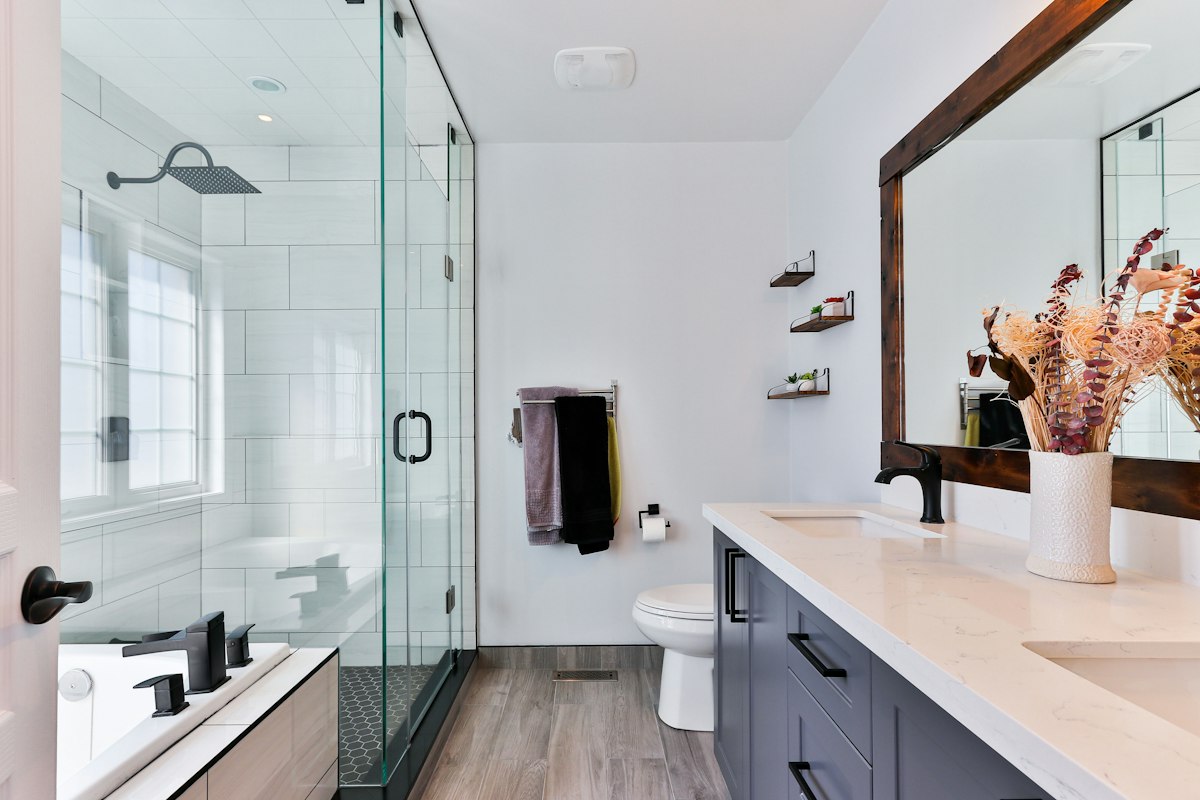
In secondary and primary bathrooms across the country, standard 60×30 inch acrylic bathtub basins sit largely unused, acting as awkward barriers for daily showering. Today’s homeowners are actively converting these cramped tub enclosures into expansive, curbless walk-in showers that evoke the feel of boutique luxury hotels.
Beyond high-end visual appeal, walk-in showers deliver critical long-term accessibility: eliminating the high threshold step-over dramatically reduces slip-and-fall hazards for residents of all ages.
Waterproofing: What Happens Behind the Tile
A common misconception is that tile and grout are waterproof. In reality, cementitious grout is porous and absorbs moisture. The true integrity of a walk-in shower relies entirely on the continuous waterproof pan and wall membrane installed beneath the tile.
| Waterproofing Method | Mechanism | Performance & Durability |
|---|---|---|
| Bonded Sheet Membrane (e.g. Kerdi) | Polyethylene fleece bonded with thin-set | Consistent thickness, vapor-proof, ready to tile immediately |
| Liquid-Applied (e.g. RedGard) | Rolled or brushed elastomeric polymer | Requires multiple coats to ensure dry-mil thickness; prone to pinholes |
| Traditional Mortar Bed + PVC Liner | Clamped vinyl pan beneath thick mud bed | Heavy, labor-intensive; moisture stays trapped in mud bed |
Linear Drains and Large-Format Tiles
Traditional center drains require a four-way compound slope (‘funnel’), forcing the installer to use small mosaic tiles so the surface can bend to the drain. Linear trench drains, positioned against the back wall, require only a single directional plane slope. This allows you to install unbroken 24×48 inch large-format porcelain tiles across the shower floor, minimizing grout lines and making cleaning effortless.
Homeowner Pro-Tip:
Always frame your shower storage niche between existing vertical studs on an interior plumbing wall rather than an exterior wall. Cutting into exterior insulation can cause winter condensation issues behind shower tile.
The Bottom Line on Shower Conversions
A walk-in shower conversion transforms everyday morning routines. Insist on rigorous unbonded membrane waterproofing, modern linear drainage, and frameless glass for an enduring, barrier-free bathroom upgrade.